One exclusive bacterial strain, refined over 15 years, now manufactured at industrial scale — and listed among China's 35 critical bottleneck technologies.
Magnetic beads are superparamagnetic microspheres: strongly magnetic in an external field, freely dispersible once it's removed. Most commercial beads are manufactured by coating an iron-oxide core with a polymer shell (polystyrene or polyvinyl chloride) and terminating it with functional groups — a process that struggles to control particle size and shape precisely.
BNCM takes a different route entirely. It is derived from the exclusively discovered Vibrio GKRZ strain — a magnetotactic bacterium — through strain modification, domestication and biosynthesis. Each bead is a single-magnetic-domain, cubic-octahedral single crystal, fixed at 50 nm, with a core of Fe₃O₄ or Fe₃S₄ wrapped in a biological membrane of phospholipids, proteins or glycoproteins.
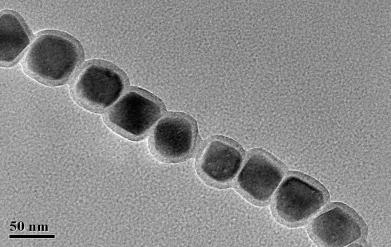
Vibrio GKRZ was isolated from a natural wetland habitat, then domesticated and genetically refined over 15 years into a strain capable of consistent, industrial-scale biosynthesis.

The exclusive Vibrio GKRZ magnetotactic strain was first isolated from its natural wetland habitat in 2005.
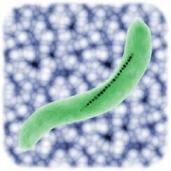
Strain modification and genetic engineering stabilised particle size at 50 nm with a fixed cubic-octahedral structure.
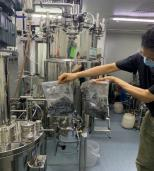
Optimised fermentation and purification protocols now support industrial-scale, batch-consistent manufacturing.
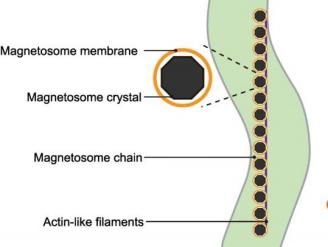
Inside the host cell, magnetosomes assemble into a chain, anchored by actin-like filaments, with each crystal wrapped in its own magnetosome membrane. Once harvested and functionalised, that same architecture gives BNCM its fast, uniform magnetic response.
| Property | Value |
|---|---|
| Average particle size | 50 nm |
| Magnetic core | Fe₃O₄ |
| Shell | Biofilm / polymer |
| Magnetic type | Paramagnetic |
| Saturation magnetisation | 4.26 µAm⁻¹ |
| Specific surface area | 23 m²/g |
| Magnetic response speed | 8–20 seconds |
| Antibody coupling capacity | > 200 µg / mg bead |
| Amino group density | > 10,000 units / single bead |
| Particle size CV | < 7% |
| Endotoxin level | < 0.1 EU/mg |
Produced by physical methods (ball milling, vapour deposition) or chemical methods (co-precipitation, high-temperature decomposition, microemulsion, hydrothermal, sol-gel).
Biosynthesised by a patented, domesticated bacterial strain under controlled fermentation — validated over 8 years of process optimisation.
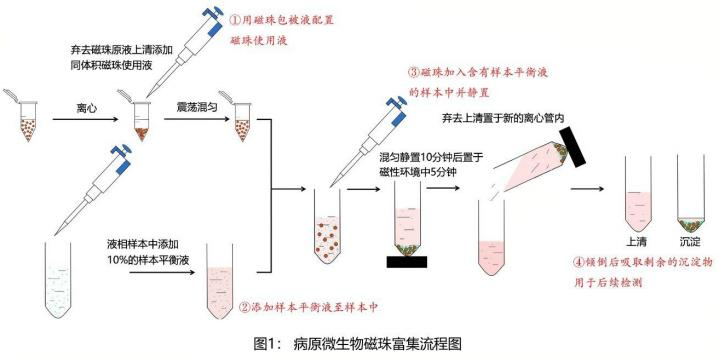
A liquid-phase sample is mixed with BNCM enrichment beads and a balancing buffer, incubated briefly, then drawn into a magnetic field. Unbound material is discarded as supernatant while the magnetically captured pellet — carrying the concentrated target microorganisms or nucleic acids — is collected for downstream testing.
BNCM beads meet the performance bar required by every major immunoassay format used in clinical diagnostics today.
Magnetic-particle chemiluminescence immunoassay — the dominant IVD format, requiring fast magnetic response and low nonspecific adsorption.
Microfluidic magnetoresistive immunoassay — direct detection of bead quantity for higher precision and speed.
Fluorescence and time-resolved fluorescence immunoassay — fast, field-deployable testing with strong sensitivity.
Femtogram-level detection through direct counting of individual antigen molecules on uniform bead surfaces.
Immune-enrichment with BNCM beads was benchmarked directly against GeneXpert, the recognised gold standard for TB testing, across a dilution series of weakly-positive samples. Enrichment lifted nucleic acid load roughly fivefold and detected samples that GeneXpert reported as negative.
Standard qPCR extraction failed to detect weakly positive COVID-19 samples (Ct: N/A). After BNCM enrichment concentrated a 3 mL sample down to 200 µL, the same samples returned clear positive calls (FAM Ct 38.23, HEX Ct 36.89) — avoiding a false negative.
Request bead samples, technical data sheets or a validation collaboration.