A fast-growing diagnostics market, a raw-material bottleneck, and a technology built to close the gap — from hospital labs to food-safety testing and beyond.
Rising infectious-disease incidence, an aging population and continued post-pandemic investment are driving steady growth in microbial diagnostics — while the upstream magnetic-bead raw material remains dominated by imported suppliers.
China ranks third among the 30 countries with the highest tuberculosis burden, with roughly 1.06 million global TB patients and 8.7 million hepatitis B patients recorded regionally. National policy — including the 13th Five-Year Plan's TB prevention programme and successive action plans on drug-resistant TB — continues to expand the diagnostic market for companies able to raise sensitivity and cut turnaround time.
China's domestic food-safety testing market is projected to reach roughly RMB 85 billion by 2025 and exceed RMB 120 billion by 2030, growing at a compound annual rate of about 12% — a market where fast, culture-free pathogen enrichment offers a direct efficiency advantage.
Pathogen enrichment for infectious disease, bloodstream infection and tuberculosis testing, plus cell sorting for cell-therapy production.
Rapid, culture-free enrichment of foodborne pathogens for testing laboratories and food producers.
Rapid testing for animal infectious disease prevention and control, plus environmental and wildlife pathogen monitoring.
Detection and monitoring of biological threat agents, plus single-crystal, single-domain beads under evaluation for electromagnetic wave-absorbing and stealth applications.
Early-stage exploration of magnetic hyperthermia, MRI contrast agents and integrated diagnosis-and-treatment platforms.
Magnetosome-based scaffolds for efficient, targeted tumour drug-delivery research.
Rare, low-frequency cell isolation for CTC detection, non-invasive prenatal diagnosis and stem-cell therapy manufacturing.
Import-substitution supply of magnetic beads, antibodies and proteins for diagnostic-kit manufacturers.
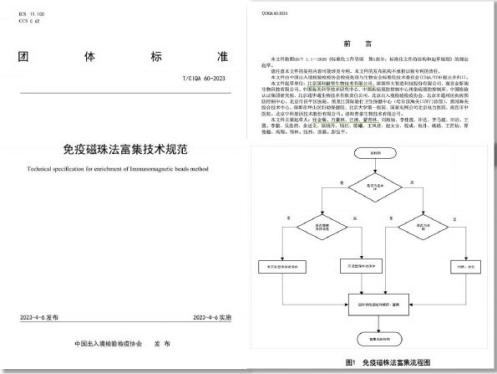
Recognising that consistent, comparable results depend on shared methodology, GKRZ led the drafting of the Technical Specification for Immune Magnetic Bead Enrichment Technology (T/CIQA 60-2023) alongside 18 other organisations — including the China Center for Disease Control and Prevention, China Customs Science and Technology Research Center, Shenzhen BGI Genomics and Nanjing GenScript Biotech.
The standard governs enrichment of trace target substances across environmental, personnel, animal, plant and object-based samples — the same methodology built into every GKRZ enrichment reagent.
Whole-blood viral nucleic acid extraction; extraction of bacterial nucleic acid from whole blood.
Rapid detection workflows built on microbial enrichment.
Chemiluminescent application of coagulation-factor micro-magnetic particles; high-sensitivity detection of infectious disease viruses.
Joint National Natural Science Foundation project on a fluorescence-conjugated magnetic bead method for bacterial nucleic acid enrichment in bloodstream infections; clinical trials initiated in 2024.
We'd like to hear about your market, your regulatory pathway, and the applications that matter most to you.